

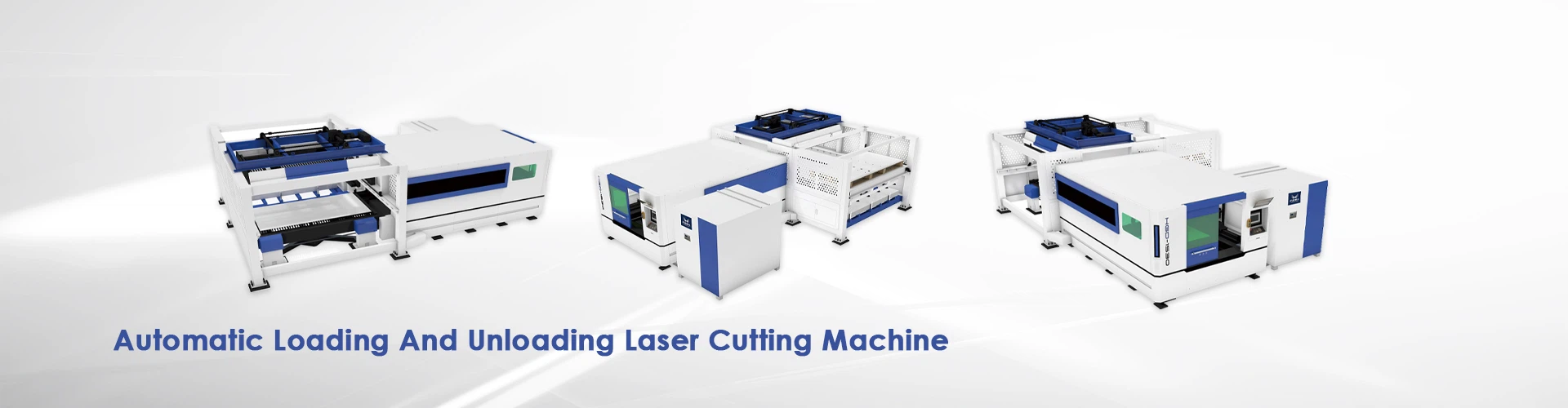
Laser Cutting And Other Types Of Thermal Cutting

What is laser cutting
Using a high power density laser beam to irradiate the material to be cut, so that the material is quickly heated to the vaporization temperature, evaporation of the formation of holes, with the movement of the beam on the material, the holes are continuously formed in a narrow width (such as 0.1mm or so) slit, to complete the cutting of the material.
Laser cutting process
Flame Cutting

Flame cutting is a standard process used for cutting mild steel, using oxygen as the cutting gas. Oxygen is pressurized to up to 6 bar and blown into the cut. There, the heated metal reacts with the oxygen: combustion and oxidation begin. The chemical reaction releases a large amount of energy (up to five times the energy of the laser) to assist the laser beam in cutting.
Gasification Cutting
Gasification cutting vaporizes the material, minimizing the impact of thermal effects on the surrounding material. This can be achieved by using a continuous CO2 laser to vaporize low-heat, high-absorption materials such as thin plastic films and non-melting materials such as wood, paper and foam.
Ultrashort pulsed lasers allow this technology to be applied to other materials. The free electrons in the metal absorb the laser and heat up dramatically. The laser pulse does not react with the molten particles and plasma, the material sublimates directly and there is no time for the energy to be transferred to the surrounding material in the form of heat. Picosecond pulses ablate the material with no visible thermal effect, no melting and no burr formation.

Melt Cutting
Melt cutting is another standard process used when cutting metals. It can also be used to cut other fusible materials such as ceramics. Nitrogen or argon is used as the cutting gas, and a gas pressure of 2-20 bar is blown through the kerf. Argon and nitrogen are inert gases, which means that they do not react with the molten metal in the kerf, but simply blow it away towards the bottom. At the same time, the inert gases protect the cut edge from air oxidation.

Compressed air cutting
Compressed air can also be used to cut thin plates. Air pressurized to 5-6 bar is sufficient to blow away the molten metal in the cut. Since nearly 80% of the air is nitrogen, compressed air cutting is essentially a melting cut.
Plasma-assisted cutting
If the parameters are properly selected, a plasma cloud will appear in the plasma-assisted melt cutting kerf. The plasma cloud consists of ionized metal vapor and ionized cutting gas. The plasma cloud absorbs the energy of the CO2 laser and converts it into the workpiece so that more energy is coupled to the workpiece and the material will melt faster, resulting in a faster cutting speed. For this reason, this cutting process is also called high-speed plasma cutting.
The plasma cloud is in fact transparent with respect to solid-state lasers, so plasma-assisted melting cutting can only be done with CO2 lasers.

Laser Cutting Characteristics
Laser cutting, compared with other thermal cutting methods, is generally characterized by fast cutting speed and high quality. Specifically summarized in the following aspects.
(1) good cutting quality: due to the small laser spot, high energy density, cutting speed, so the laser cutting can get a better cutting quality. ① laser cutting kerf is fine and narrow, the two sides of the slit is parallel and perpendicular to the surface, the dimensional accuracy of the cut parts can reach ± 0.05mm. ② cutting surface is clean and beautiful, the surface roughness is only a few tens of microns, and even laser cutting can be used as the last process, without mechanical processing, parts can be used directly. (③ material after laser cutting, the heat affected zone width is very small, the performance of the material near the slit is also almost unaffected, and the workpiece deformation is small, high cutting accuracy, the geometry of the slit is good, the shape of the slit cross-section presents a more regular rectangular shape.
(2) high cutting efficiency: due to the transmission characteristics of the laser, laser cutting machine is generally equipped with a number of CNC workstations, the entire cutting process can be fully realized CNC. Operation, only need to change the CNC program, can be applied to different shapes of parts cutting, both two-dimensional cutting, but also to achieve three-dimensional cutting.
(3) cutting speed: with a power of 1200W laser cutting 2mm thick mild steel plate, cutting speed of up to 600cm/min; cutting 5mm thick polypropylene resin plate, cutting speed of up to 1200cm/min. materials in the laser cutting does not need to be clamped and fixed, both to save the tooling clamps, but also saves the auxiliary time of the upper and lower materials.
(4) non-contact cutting: laser cutting torch and workpiece without contact, there is no tool wear. Processing of different shapes of parts, do not need to change the "tool", only need to change the output parameters of the laser. Laser cutting process is low noise, low vibration, no pollution.
(5) Cutting a variety of materials: metal matrix composites, leather, wood and fiber. But for different materials, due to their own thermophysical properties and different absorption rates of the laser, performance