

What Are The Ten Advantages Of Laser Welding Machine?
With the continuous upgrading and transformation of laser welding technology, laser welding technology has undergone a qualitative leap. Now, laser welding machines have been maturely used in many fields, such as high-tech electronics, automobile manufacturing, precision machining and other fields. As a direction of laser application, laser welding is a combination of current technology and traditional technology, but it has different advantages from traditional processing.

1. The laser beam quality is good
After the laser is focused, the power density is high. After the high-power low-order mode laser is focused, the focal spot diameter is small.
2. The laser welding speed is fast, the depth is large, and the deformation is small.
Due to the high power density, small holes are formed in the metal material during the laser welding process, and the laser energy is transmitted to the deep part of the workpiece through the small holes with less lateral diffusion. Therefore, the material fusion depth is large during the laser beam scanning process. Fast speed, large welding area per unit time.
3. Laser welding is especially suitable for welding precision sensitive parts
Due to the large welding aspect ratio, small specific energy, small heat-affected zone and small welding deformation, the laser welding machine is especially suitable for welding precision and heat-sensitive parts, which can eliminate post-weld correction and secondary processing.
4. High flexibility of laser welding machine
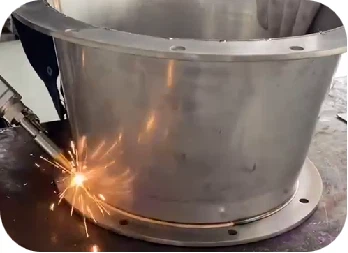
The laser welding machine can realize welding at any angle, and can weld inaccessible parts; it can weld various complex welding workpieces and large workpieces with irregular shapes. There is great flexibility to achieve any angle welding.
5. Laser welding can weld difficult-to-weld materials
Laser welding can be used not only for welding between various dissimilar metal materials, but also for titanium, nickel, zinc, copper, aluminum, chromium, niobium, gold, silver and other metals and their alloys, steel, Kovar, etc. Welding between alloy materials.
6. Low labor cost of laser welding machine
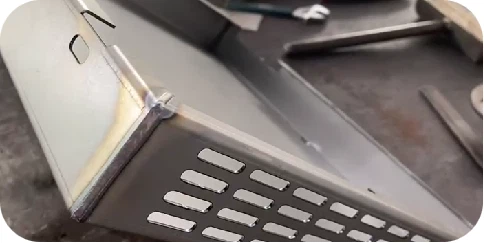
Since the heat input during laser welding is extremely low, the deformation after welding is very small, and a very beautiful welding effect can be achieved, so the follow-up processing of laser welding is very small, which can greatly reduce or eliminate the labor on the huge polishing and leveling process. .
7. The laser welding machine is easy to operate
The welding equipment of the laser welding machine is simple, the operation process is simple and easy to learn, and it is easy to get started. The professional requirements of the staff are not high, and labor costs are saved.
8. The laser welding machine has strong safety performance
The high-safety welding tip is only effective when the switch is touched when it touches the metal, and the touch switch has body temperature sensing.
9. The working environment of laser welding machine is varied
Laser welding machines can be used in various complex working environments and can be welded at normal temperature or under special conditions. For example, laser welding is similar to electron beam welding in many ways. Its welding quality is slightly inferior to electron beam welding, but the electron beam can only be transmitted in a vacuum, so the welding can only be carried out in a vacuum, and the laser welding technology can be more advanced. Used in a wide range of work environments.
10. The welding system is highly flexible and easy to automate.
However, laser welding machines also have certain limitations. Due to the higher cost of laser-related systems, the one-time investment cost will be higher. In addition, the laser welding machine also requires high installation accuracy of the weldment, and requires that the position of the light source on the commodity workpiece should not have obvious deviation.
It can be seen that the laser welding machine is much better than the traditional welding method. It has broad prospects.
 |  |
 |  |